

Prof. Dr. rer. nat. Katrin Salchert
(Kopie 2)
Chair
Natural Products Chemistry
Key areas of focus
The Chair of Natural Product Chemistry focuses on various aspects of metabolic processes in living matter, i.e. the organic chemistry of biological transformations and their ex vivo application. Key areas of focus include, in addition to the fundamentals of organic chemistry, the biosynthesis of relevant compounds in living matter, enzyme-mediated metabolic transformation both within and outside organisms, and the use of biopolymers for material design and interfacial functionalisation.
Prof. Dr. rer. nat. Katrin Salchert
- S 428
- +49 351 462 2538
Consultation hours
From 30 September 2026, every Wednesday from 11.15 am to 12.30 pm in room S 428.
Enzyme-catalysed transformation
The ex vivo use of enzymes in metabolic processes, even outside living organisms, is of particular importance due to the environmentally beneficial nature of the reaction conditions. Immobilised enzymes are the method of choice for ensuring continuous reactions, which is often required. When producing appropriately functionalised supports, the enzyme immobilisation is always optimised depending on the specific application, taking into account the enzyme and support material used. The quantification of the amount of immobilised protein, the associated enzyme activity and the time-dependent stability of the resulting support are key parameters for evaluating enzyme immobilisation.
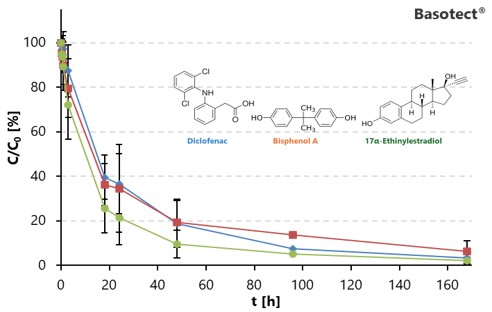
The increased presence of persistent synthetic organic carbon compounds (SOCs) in surface waters, sewage effluent and wastewater has become an ever-greater focus of public and research attention in recent years. Particularly for drinking water abstraction via bank filtration and groundwater infiltration, comparatively high levels of anthropogenically introduced contaminants represent a serious and increasingly pressing problem in terms of the chemical pollution of our surface waters. As many of these substances – particularly active pharmaceutical ingredients – cannot be removed, or can only be removed inadequately, by conventional wastewater treatment technology, partly due to their polarity, supplementary processes are already being tested and, in some cases, implemented to reduce the accumulation of problematic compounds in the aquatic ecosystem. However, many of these methods, which supplement conventional wastewater treatment, are characterised by high maintenance requirements and, in many cases, high energy consumption.
A promising approach to addressing the problem described is the use of oxidising enzymes, such as horseradish peroxidase or laccase, to produce suitable immobilised enzymes through the functionalisation of porous carrier materials. The functionality of this approach can be demonstrated on various support materials for compounds with ecotoxicological potential, such as diclofenac, ethinyl oestradiol and bisphenol A. The functionality of this approach has been demonstrated, for example, by the laccase-catalysed transformation of the aforementioned compounds on various support materials, in this case Basotect. The covalent immobilisation of the enzyme is achieved, amongst other things, via a reactive polymeric intermediate layer.
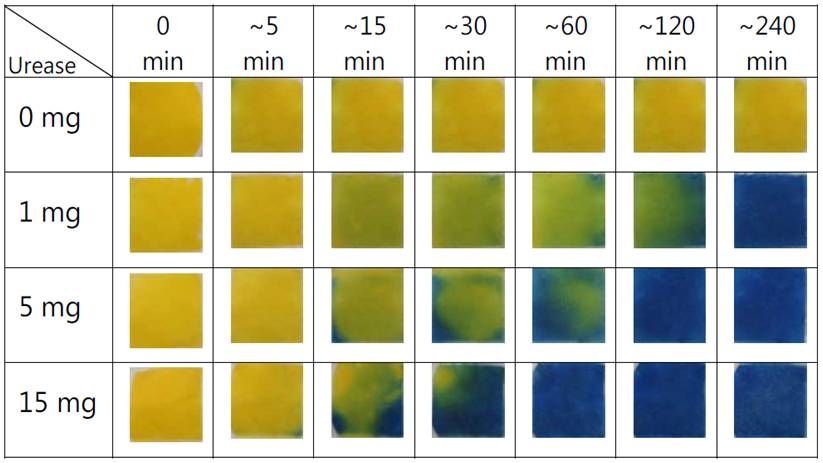
Breaches in the food cold chain are not usually apparent to the consumer and therefore potentially create uncertainty regarding the freshness of food, particularly frozen food. Using immobilised enzymes, such events can be visualised via smart labels, as enzyme activity is minimal in a frozen state and the water required for the reaction cannot participate in the reaction whilst frozen, meaning that, in effect, no enzymatic reaction takes place. If the temperature is raised from -18 °C, the thawing of the system triggers an enzymatic reaction, which is made visible, for example, by a corresponding optical indication.
In the example shown, a prototype consisting of urease immobilised on cellulose, with urea as the substrate and bromothymol blue as the indicator, was developed; this visualises (undesirable) thawing processes via a colour change. Depending on the amount of immobilised enzyme, the thawing of a frozen product can be indicated over easily measurable time periods. Potential areas of application are seen not only in the food retail sector but also, for example, in the handling of medical products (e.g. medicines).
Collagen-based cell culture substrates
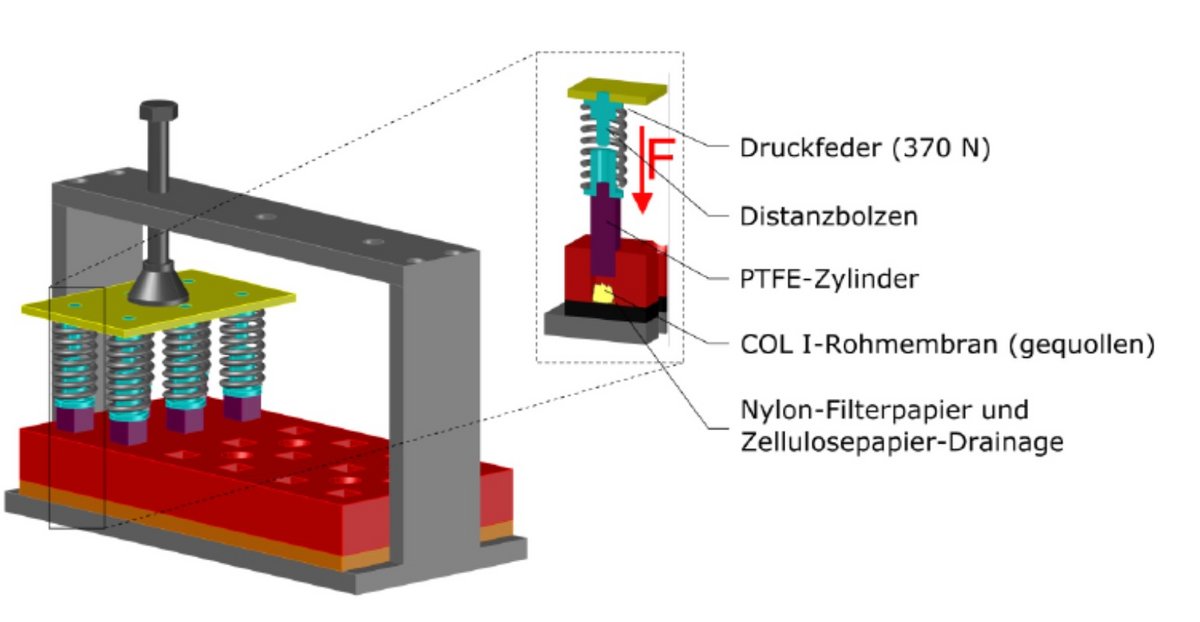
Type I collagen is a common protein found in the animal extracellular matrix and interacts with more than 50 different compounds, in particular other biopolymers such as glycosaminoglycans. Owing to these properties, as well as its ability to reconstruct its natural fibrillar structure in vitro, type I collagen is particularly well suited to the preparation of cell culture substrates.
Teaching in the winter term 2026/27
Internship dates for the winter semester 2026/27
- 2–3 December 2026
- 16–17 December 2026
in Lab N 417 from 1.45 pm to 4.45 pm
Practical sessions every Friday on a fortnightly basis, starting on 16 October 2026, Room S 529
Internship days in the winter semester 2026/27
- 7–8 October 2026
- 21–22 October 2026
- 4–5 November 2026
- 19 November 2026
All sessions will take place in Laboratory N 417 from 1.45 pm to 4.45 pm
Field trip in January 2027
I am happy to provide academic supervision for placements and final-year projects within the degree programmes of the Faculty of Agriculture/Environment/Chemistry in the following subject areas:
- Interfacial functionalisation and enzyme immobilisation
- Proteins and enzymes
- Biotransformation
- Preparation and characterisation of cell culture substrates
- Low-molecular-weight natural products and biopolymers
- Natural product and trace analysis
- as well as other topics relating to organic and natural product chemistry