

TRIZ Reverse – From Solution to Problem
Latest news
Innovation Blog of the RKW Competence Center (2024): Article by Prof. Günther on TRIZ Reverse & AI
Project description
TRIZ Reverse – Development of a software-based solution for patent analysis and exploitation [FORZUG III]
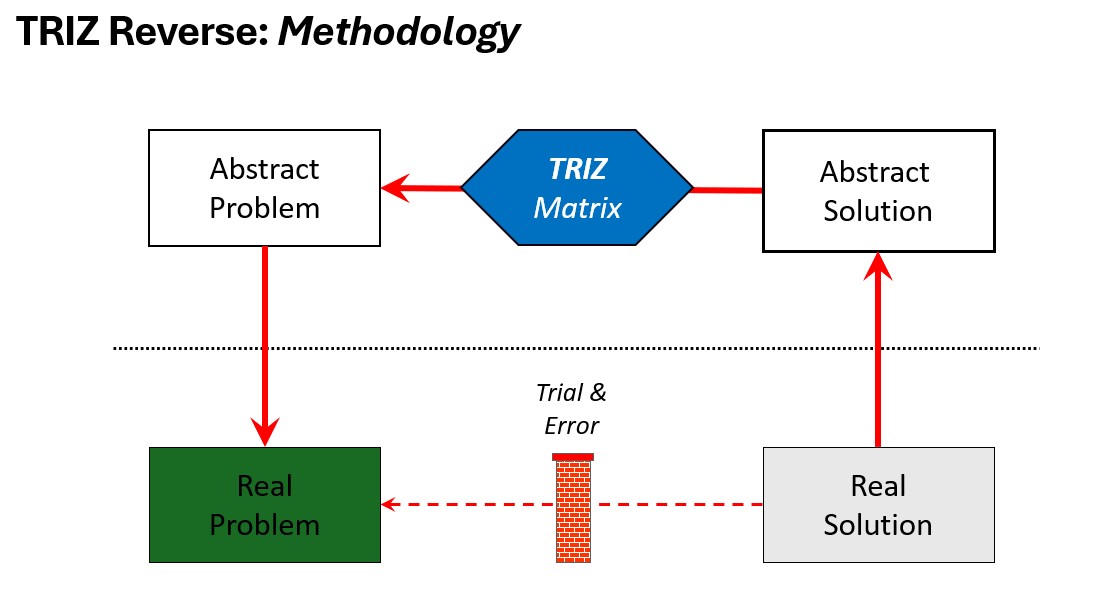
TRIZ Reverse is a systematic approach to exploiting the economic potential of patents. The seven-step TRIZ Reverse algorithm was developed at the Dresden University of Applied Sciences (HTWD). This enables new exploitation opportunities for a patent to be identified. The TRIZ Reverse algorithm is currently applied largely manually using Excel spreadsheets. Analysing a single patent therefore takes a relatively long time (several days) and can generally only be carried out with expert support. A user-friendly solution that allows TRIZ Reverse to be applied quickly and without external assistance requires a (professional) software solution.
Background
TRIZ (a Russian acronym) or TIPS (Theory of Inventive Problem Solving) is a method recognised in both academia and industry for inventive problem-solving. It involves the systematic resolution of technical contradictions in order to generate innovations. A key element of the TRIZ methodology is the abstraction of the existing problem in order to find innovative solutions. Based on Genrich S. Altschuller’s conflict matrix (1984), there are numerous documented case studies that demonstrate the effectiveness of TRIZ. The approach and methodology for determining the ‘principles of application’ in TRIZ Reverse are based on this classic TRIZ. However, instead of moving ‘from problem to solution’, the reverse path is taken, namely ‘from solution to problem’.
Publications
- TRIZ Reverse – Specification and application of a 7 step-by-step approach for systematic knowledge and technology transferpdf - 753 kB
Silvia Liubenova Popova, Sergio Garzon, Matthias Bauch, Swen Günther in: TRIZfest 2021 Conference proceedings, S. 184-195
- A systematic review and comparison with existing knowledge and technology transfer toolspdf - 812 kB
Sergio Garzon, Silvia Liubenova Popova, Matthias Bauch, Swen Günther in: TRIZfest 2021 Conference proceedings, S. 196-206
Weitere Dokumente/ Antragsformulare finden Sie hier: https://www.htw-dresden.de/en/university/facultys/business-administration/translate-to-english-forschung/translate-to-english-prozess-/innovationsmanagement/triz-reverse
Patent analyses using TRIZ Reverse
| Organisation | Patent analysis | Fields of application |
|---|---|---|
| HTW Dresden: Faculty of Agriculture, Chemistry and Environment | DE102017123891: Biocompatible moulded part and method for producing a collagen-based layered material | Originally: Medicine/Pharmaceuticals, new in TRIZ Reverse: Packaging industry |
| Max Planck Institute for the Physics of Complex Systems, Dresden | US000010241539B2: Self-synchronisable network: A solution for synchronising a network comprising a plurality of interconnected nodes | Open |
| Fraunhofer Institute for Process Engineering and Packaging IVV, Dresden | DE102018002011A1: Pulse impact method for the thermal joining of thermoplastic fibre-reinforced components, e.g. thin films | Originally: Packaging industry, now with TRIZ Reverse: Textile industry |
project team
Prof. Dr. rer. pol. Swen Günther
Chair of Process and Innovation Management
- Z 619
- +49 351 462 3337