

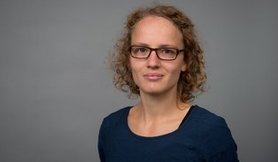
Prof. Dr. rer. nat. Cordula Vogel
Professur
Bodenkunde und Pflanzenernährung
Lehrveranstaltungen
- Bodenkunde, Umweltprojekt Boden
- Pflanzenernährung und Düngung
- Bewertung von Landnutzungen mit moderner Boden- und Pflanzenanalytik
- Management natürlicher Ressourcen
- Projektstudium Landschaftsentwicklung
Prof. Dr. rer. nat. Cordula Vogel
- P2 105
- +49 351 462 3035
akademischer Werdegang
- seit 09/2026: HTW Dresden-Pillnitz
Professorin (W2) für Bodenkunde und Pflanzenernährung - 04/2015 - 08/2026: TU Dresden, Bereich Forstwissenschaften
Assistant Professor am Institut für Bodenkunde und Standortslehre - 04/2011 - 12/2014: TU München
Doktorandin am Lehrstuhl für Bodenkunde
Dissertation: „Mikrostrukturen der Mineralphase bestimmen den Verbleib von organischem Kohlenstoff und Stickstoff im Boden“ (summa cum laude)
Mitglied der IGSSE (International Graduate School of Science and Engineering) - 10/2005 - 03/2011: MLU Halle-Wittenberg
Studium der Agrarwissenschaften, Diplom-Agraringenieurin (Dipl.-Ing. agr.)
Diplomarbeit: „Initiale Bodenentwicklung im Vorfeld des Arolla-Gletschers“ (Note 1,1)
Wissenschaftliche Qualifikationen
- 11/2019: Teilnahme am Workshop INIA-JKI in Montevideo, Uruguay: Towards more sustainable agriculture through managing the soil microbiome
- 06/2019: Teilnahme am MaxIV ESS workshop Soil Science in Lund, Schweden
- 10/2018: Teilnahme am Advanced Biofilm Course, UFZ Magdeburg
- 2017-2018: Mentee des Maria Reiche Mentoring Programms der TU Dresden
Forschungsschwerpunkte
Der Fokus meiner Forschung liegt auf dem biogeochemischen Prozessverständnis von Böden auf verschiedenen räumlichen Skalen von der Mikroskala bis hin zur Landschaftsebene:
- Organischer Kohlenstoff in Böden, dessen Umsatz und Speicherung
- Extrazelluläre polymere Substanzen (EPS) und deren Funktionen
- Interaktion von Enzymen mit der Mineralphase
- Visualisierungsverfahren (insbesondere ESEM)
- Nährstoffkreisläufe in Böden
- Bodenstruktur, Aggregierung und deren Einfluss auf die Bodenerosion
Auszeichnungen
- 2015: Promotionspreis 2015, Bund der Freunde der TU München
- 2015: Posterpreis des 5th International Symposium on Soil Organic Matter
- 2014: Förderpreis der Dr. Heinrich-Baur-Stiftung des Wissenschaftszentrums für Ernährung, Landnutzung und Umwelt Weihenstephan, TU München
- 2014: Posterpreis der DBG, Kommissionssitzung
- 2011: Posterpreis der Deutschen Bodenkundlichen Gesellschaft (DBG)
Publikationen (Auswahl)
- Kamamia, A.W.; Vogel, C.; Mwangi, H.M.; Feger, K.H.; Sang, J.; Julich, S. (2021): Mapping soil aggregate stability using digital soil mapping: A case study of Ruiru reservoir catchment, Kenya. - Geoderma Regional 24, e00355 https://www.sciencedirect.com/science/article/pii/S2352009420301048
- Vuko, M., Cania, B., Vogel, C., Kublik, S., Schloter, M., & Schulz, S. (2020). Shifts in reclamation management strategies shape the role of exopolysaccharide and lipopolysaccharide‐producing bacteria during soil formation. Microbial Biotechnology, doi: 10.1111/1751-7915.13532
- Gao, J., Mikutta, R., Jansen, B., Guggenberger, G., Vogel, C., & Kalbitz, K. (2020). The multilayer model of soil mineral–organic interfaces–a review. Journal of Plant Nutrition and Soil Science, in press, DOI:10.1002/jpln.201900530
- Zethof, J. H., Leue, M., Vogel, C., Stoner, S. W., & Kalbitz, K. (2020). Identifying and quantifying geogenic organic carbon in soils–the case of graphite. SOIL 5, 383-398
- Olagoke, F. K., Kalbitz, K., & Vogel, C. (2019). Control of Soil Extracellular Enzyme Activities by Clay Minerals—Perspectives on Microbial Responses. Soil Systems 3, 64; doi:10.3390/soilsystems3040064
- Gao, J., Jansen B., Cerli C., Helmus R., Mikutta R., Dultz S., Guggenberger G., Vogel C., and Kalbitz K. (2018). Organic matter coatings of soil minerals affect adsorptive interactions with phenolic and amino acids. European Journal of Soil Science 69, 613-624
- Doetterl, S., A. A. Berhe, C. Arnold, S. Bodé, P. Fiener, P. Finke, L. Fuchslueger, M. Griepentrog, J. W. Harden, E. Nadeu, J. Schnecker, J. Six, S. Trumbore, K. Van Oost, C. Vogel, and P. Boeckx. (2018). Links among warming, carbon and microbial dynamics mediated by soil mineral weathering. Nature Geoscience, 11, 589–593
- Pronk, G. J., K. Heister, Vogel C., Babin D., Bachmann J., Ding G.-C., Ditterich F., Gerzabek M. H., Giebler J., and Hemkemeyer M., Kandeler E., Mouvenchery Y.K., Miltner A., Poll C., Schaumann G.E., Smalla K., Steinbach A., Tanuwidjaja I., Tebbe C.C., Wick L.Y., Woche S.K., Totsche K.U., Schloter M. & Kögel-Knabner I. (2017). Interaction of minerals, organic matter, and microorganisms during biogeochemical interface formation as shown by a series of artificial soil experiments. Biology and Fertility of Soils, 53, 9–22
- Vogel, C., K. Heister, F. Buegger, I. Tanuwidjaja, S. Haug, M. Schloter, and I. Kögel-Knabner. (2015). Clay mineral composition modifies decomposition and sequestration of organic carbon and nitrogen in fine soil fractions. Biology and Fertility of Soils, 51, 427–442
- Vogel, C., Babin D., Pronk G., Heister K., Smalla K. and Kögel-Knabner I. (2014): Establishment of macro-aggregates and organic matter turnover by microbial communities in long-term incubated artificial soils. Soil Biology and Biochemistry, 79, 57-67
- Vogel, C., C. W. Mueller, C. Höschen, F. Buegger, K. Heister, S. Schulz, M. Schloter, and I. Kögel-Knabner. (2014). Submicron structures provide preferential spots for carbon and nitrogen sequestration in soils. Nature Communications 5, 2947, doi: 10.1038/ncomms3947
- Babin, D., Vogel C., Zühlke S., Schloter M., Pronk G. J., Heister K., Spiteller M., Kögel-Knabner I. and Smalla K. (2014). Soil mineral composition matters: response of microbial communities to phenanthrene and plant litter addition in long-term matured artificial soils. PLOS ONE, 9 (9), doi: 10.1371/journal.pone.0106865